
Operation Dragonfly
The first deployment of ATACMS in Ukraine’s hardest strike yet against the Russian Air Force

For more than a year, Ukraine had been begging Washington to send MGM-140 Army Tactical Missile Systems (ATACMS) which are capable of precision strikes against Russian targets deep behind the current frontlines. This led to a heated discussion on the delivery of the weapon system in the US, marked by a public back-and-forth on whether President Biden would agree to transfer as in the cases of M1 Abrams main battle tanks (MBTs) and F-16 fighter jets. In the night from the 16-17 October, the successful shipment of ATACMS was manifested with a big bang.
In an operation dubbed “Dragonfly”, the Ukrainian Special Operations Forces (SOF), in cooperation with the Ukrainian Air Forces (PS ZSU), deployed ATACMS for the first time. The Ukrainian General Staff has apparently handed over the missiles to its special operators to ensure that they reach their maximum effect. This effect was actually achieved, as two air bases in the Russian-occupied cities of Berdyansk and Luhansk, several dozen miles deep in the hinterland, were struck at 04:00 and 11:00 local time. They are out of range of Guided Multiple Launch Rocket Systems (GMLRS), which only have a range of 50 miles (80 km) and are launched by M412 High Mobility Artillery Rocket Systems (HIMARS).
Berdyansk is of particular strategic importance as it lies between Mariupol and Crimea, making it an important logistical hub on the land route between the Russian-occupied territories in the Donbas and the Crimean peninsula. Video footage from airfield there showed several explosions and long-lasting heavy fires due to the detonation of ammunition after the Ukrainian attack.1 Among the dead is said to be Major Sergei Petrovich Korolenko, chief engineer of the flight service of the 696th Research and Instructor Helicopter Test Helicopter Regiment of the 344th Centre for Combat use and Retraining of Flight Personnel of Army Aviation.2
According to the American business magazine Forbes, three ATACMS were used for the attack on the Berdyansk air base.3 Western media outlets like The Wall Street Journal (WSJ), The New York Times (NYT) and Politico also reported the use of ATACMS.4 The missiles used are said to be the M39 variant of ATACMS with M74 submunitions.5 The use of this variant was confirmed by evidence from the ground, including remains of an ATACMS missile and half-destroyed M74 submunition.6The Commander-in-Chief of the Armed Forces of Ukraine (AFU), General Valery Zaluzhny, released a statement confirming the use of the ATACMS along with a video of their being launched, although he otherwise rarely comments ongoing military operations.7 Zelensky confirmed their use indirectly in his nightly address on 17 October, saying that “ATACMS have proven themselves.”8
The Ukrainian SOF reported that the attacks delivered heavy blows on the tactical military airfields in Berdyansk and Luhansk. They claim that nine helicopters, ammunition depots, an air defence launcher and special military equipment were destroyed. Moreover, runways are also said to be damaged, and dozens of Russian occupation troops killed.9 This report was affirmed by the Ukrainian Ministry of Defense (MoD).10 It was confirmed by Frontelligence Insight, a team of OSINT (Open Source Intelligence) experts under the leadership of a Ukrainian reserve officer. The team stated that Russian forces had Mi-28, Mi-24 and Ka-52 helicopters at the Berdyansk airfield prior to the attack and that the extent of the damage is probably greater than first seen in satellite imagery.11 The UK Mod claimed that nine Russian military helicopters were destroyed at Berdyansk and five at Luhansk.12 According to the Dutch open source intelligence website Oryx, which tracks Russian military equipment losses, Seven Ka-52 and two Mi-8 helicopters were destroyed in the strikes.13 Furthermore, Oryx analyst Jakub Janovsky confirmed that another 15 helicopters were possibly destroyed.14 Overall, 21 helicopters were destroyed or damaged, according to other OSINT experts.15
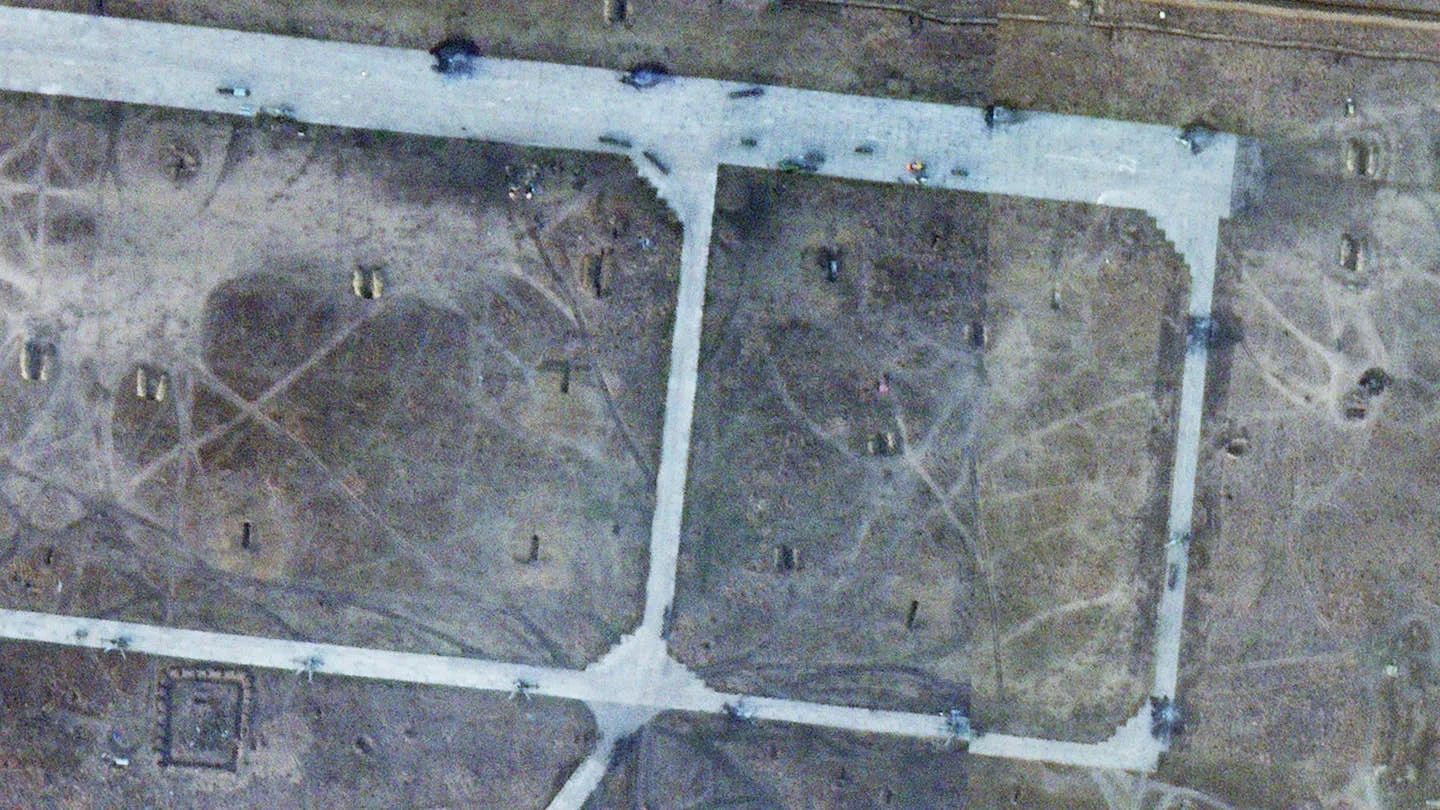
Russia had stationed helicopters at the Berdyansk and Luhanks air bases because it thought they were safe there. They played an important role in the Russian defence against the ongoing Ukrainian counter-offensive on the Zaporizhzhya front, especially in June and July 2023 in the western part of the oblast. Whenever Ukrainian mechanized forces began to penetrate the Russian defence lines, the Russian command called in rotary-wing aircraft as a kind of fire-brigade which would force the attacking units to retreat, in particular due to a lack of close air support. This was especially true of the Ka-52 helicopters stationed at the Berdyansk airbase, which had caused significant problems for Ukrainian battle tanks and infantry fighting vehicles at the beginning of counter-offensive. With here attack on the air bases, Ukraine therefore again chose high-value targets, as it did before with the attacks on Russian warships in the port of Sevastopol and the headquarters of the Russian Black Sea Fleet (BSF).
It would be wrong to claim that the Russian military didn’t adapt and learn during the course of the war. Such a claim, made by some overly optimistic and enthusiastic Ukrainians and supporters of Ukraine after the Russian defeat in the Battle of Kyiv in early April 2022 and the successful Ukrainian counter-offensives in the Kharkiv and Kherson oblast in autumn the same year, underestimates the capabilities of the Russian military and downplays the difficulties faced by the AFU in their efforts to liberate the occupied Ukrainian territories. That doesn’t help Ukraine’s defence campaign, on the contrary.
On the other side, the Russian military is still not adapting in a way that many so called western “experts” who praise his abilities like to pretend, exaggerating the degree of its adaptation. It’s still a constant pattern that Russian military must first suffer serious setback it should have prepared for before it adapts to new Ukrainian capabilities. This was proved again with Operation Dragonfly. Although the operation itself was a surprise, it was to be expected that Kyiv would receive ATACMS sooner or later because signs of their delivery had been building recently. The handover therefore was telegraphed, though not its exact timing. Nonetheless, the Russian military “left a huge stock of very valuable helicopters sitting out in the open, relatively bunched together, to be the most inviting of targets”, as Phillips O’Brien puts it.16
Ukraine succeeded in striking the hardest blow against the Russian Aerospace Forces (VKS) in the entire course of the war, leading to the worst losses they have suffered in a single day. The AFU were able to coordinate and carry out these attacks instantly, so that the Russian military could not react in time. This shows how much damage they can do with ATACMS. Consequently, widespread fear over their use was expressed in the Russian information space. Russian military bloggers characterised the strikes as a significant setback and even bemoaned them as one of the most, if not the most severe Ukrainian strikes since the start of the full-scale invasion.17 Operation Dragonfly demonstrated Ukraine’s extended capability to hit key targets deep inside Russian-held territory which allows it to significantly damage the Russian arsenal and decimate Russian troops far from the front lines.
The decision to deliver ATACMS represents another U-turn by the US government. So far, the White House had deflected Ukraine’s demands. As with other weapons systems, it had claimed that such a delivery would cross a “red line” of Putin and thus increase the risk of a nuclear escalation. It also expressed concern that Ukraine could use the long-range version of the missiles to hit targets deep inside Russia and argued that it needed the system in other war theatres. Biden even claimed that sending ATACMS was no longer necessary because Britain and France each had agreed to send Storm Shadows/SCALP air-launched cruise missiles (ALCMs).18
However, these “arguments” were obviously excuses. The Ukrainian counter-offensives had already proved time and again that the Kremlin doesn’t react to the crossing of “red lines”, partly set by the West itself, with an “escalation”, certainly not with a nuclear one. In its hubris, the West imagines that it has a decisive influence on whether and how Russian fascism escalates its war of extermination against the Ukrainian people. In reality, however, the dynamics of this escalation is mainly due to the genocidal character of the war itself, which is relatively independent of the West’s behaviour. The view that the West could exert a decisive influence on Putin was precisely one of the central misconceptions that encouraged appeasement towards Russian fascism, ignoring the fact that the foreign and geopolitical actions of Russia depend much more on its internal constitution and its domestic policies. Moreover, Ukraine had pledged to not fire ATACMS into Russia’s internationally recognized borders, assurances it also gave when Britain and France send them their long-range missiles. By refusing to provide the missile system, the White House was drawing an arbitrary line from the start.
Indeed, Putin reacted to Operation Dragonfly with downplaying the thread posed by ATACMS for the Russian military and the impact the weapons will have in the theatre of war.19 Speaking with journalists at the end of his visit to China, the fascist leader admitted that the delivery of the long-range missiles “pose a threat” but would be “completely unable to drastically change the situation along the line of contact. It's impossible.”20 Contrary to this propagandistic claim, the Russian military actually has no effective defence against ATACAMS. Its air defence systems won’t save it.As the analyst Brynn Tannehill emphasises, ATACMS are more difficult to shoot down than cruise missiles because they are ballistic missiles. The only system with a credible anti-ballistic missile capability are S-400 surface-to-air missile, which are Russians’ best air defence system. But even S-400 batteries can’t reliably intercept cruise missiles, let alone ballistic missiles.21 As if to confirm this, the AFU attacked several S-400s in Luhansk oblast in their second-ever strike with the M39-ATACAMS, just nine days after the strikes against the air bases. As O’Brien claims, they seemed to have destroyed at least three of the systems with using just a few of the missiles.22
Biden informed Ukrainian President Zelensky about the decision to send ATACMS when they met at the White House on 21 September, after he signed off on the handover in the weeks before. According to officials familiar with the conversation, Biden told the Ukrainian president that he had changed his earlier mind and agreed to supply the M39 version of the missile system.23 One of the main reasons for this U-turn was probably that Ukraine had already obtained Storm Shadows/SCALPS, which allowed it to attack Russian targets deep behind the front lines. From an excuse, these systems would become a reason for the delivery of ATACAMS, as the Ukrainian military proved its effective use of these systems and kept its promise not to attack targets inside Russia. This shows how arbitrary the excuses were for not sending them to Kyiv. In final days before Operation Dragonfly, the US delivered around 20 ATACMS in secret, probably out of concern that they could be attacked by Russia during their shipment into Ukraine, according to the NYT.24 Furthermore, they likely were concerned that the Russians would move military equipment out of reach before the missiles could be used but wanted to provide the AFU with operational surprise.
The M39s are the oldest version of the ATACMS, but also one of the most powerful deep-strike munitions in the US arsenal. It’s equipped with a cluster warhead containing 950 bomblets that spin rapidly on impact in the air and become armed once they reach a speed of about 2,400 revolutions per minute before detonating on impact. They are area weapons that don’t penetrate concrete and steel like Storm Shadows/SCALPs but scatter their submunitions across potentially thousands of square yards.25 They are therefore particularly well suited against lightly armoured targets that are relatively close together. Such targets can now be more widely destroyed because Ukraine was only able to conduct strikes on individual Russian assets with previously available missiles. M39s are also particularly effective against targets that could be moved quickly because of their high speed. They’re thus rendering more difficult Russia’s use of attack helicopters against the Ukrainian counter-offensive, as these being the types of thin-skinned targets that are vulnerable. In this way, the M39 version of ATACMS can help to suppress Russian air power without actually striking all of its front-line airfields.
Moreover, while Storm Shadows/SCALPs are the longest-range missiles available to Ukraine so far, they’re air-to-surface missiles (ASMs). The Ukrainian warplanes, which they’re launched by, must potentially expose themselves to Russian surface-to-air missiles (SAMs) and fighter jets. This limits when and where the AFU can use this kind of missiles. In contrast, ATACMS are surface-to-surface missiles (SSMs) that can be fired from HIMARS or the M270 Multiple Launch Rocket System (MLRS). This has several advantages. First, it allows them to be mobile. They can be quickly moved to impose uncertainty for the Russian military about where they’re launched from, disperse, and hide after firing. Therefore, Russian counterattacks can be avoided through shoot-and-scoot. Secondly, HIMARS doesn’t necessarily reveal if they’re carrying GMLRS or ATACMS which has the advantage that the Russian military won’t know the typ of missiles, not even through surveillance. Furthermore, there’s no shortage of M39s in the US warehouses. The Biden administration could supply Ukraine with enough of these missiles to hold at risk vital Russian installations throughout occupied Ukraine for at least a year.26
On the other hand, the M39 is a variant of the ATACMS, called Block I, which has a shorter range than other variants. While later generation can reach up to 186 miles (300 kms), it can only reach just over 100 miles (165 kms).27 Newer versions have a single explosive charge in their warheads but weren’t delivered because the US concluded that its own stockpile of those was so small that it could not afford to give them up.28 What the Biden administration seems to have forgotten is that Ukraine is fighting the very defensive war against Russian imperialism for which NATO was originally founded. The US is currently not engaged in any war of its own, let alone one of the immense scale and genocidal character of Russian fascisms against Ukraine. Even if one were to argue that the US needed other variants of the ATACMS to assist Taiwan in defending itself against a potential Chinese attack, it is Ukraine's defensive struggle that drastically reduces the likelihood of such an attack.
The deployment of the 39Ms comes at a critical time, as the Ukrainian counter-offensive encounters strong Russian defences and is losing momentum. Although it’s not clear yet how much of a difference the missile system will make on the battlefield, it allows the AFU to hit substantial logistics and command posts at many operational depths of the frontlines, meaning that they can hit Russian targets deep in occupied Ukraine. Even if it’ss not possible to place HIMARS or the M270 MLRS as missile launchers directly on the front line, as this would expose them, the 39Ms still offer the advantage of being able to carry out area attacks where the Kremlin previously thought it was safe.
Ukraine now has another precision weapon system that threatens the Russian land corridor in the south of the country because it has the entire coastal strip between the front line and the Sea of Azov within its reach. The missile system gives Ukraine the ability to hold Russian high-value assets at risk as long as they’re used to occupy parts of the country. This further increases the pressure on the Russian military to either fortify or further disperse their logistics and command posts, with the risk of over-extending them along longer ground lines of communications (GLOCs). The Russian command will have to consider the potential thread of M39s when making operational and tactical decisions about the placement of military assets. That also includes its occupied air bases. The VKS are forced to relocate its aircraft and other aviation assets further away from the frontline because M39s could strike them at any time. These assets must be pulled out of air bases in occupied Ukraine and instead be operated from bases outside of range, in Russia proper. This will disrupt Russian aviation support as the loiter time will be shortened by the additional distance. In addition, the dispersal of aircraft could also lead to more problems in their coordination and maintenance, as the Institute of the Study of War (ISW) points out.29
In that way, M39s can help Ukraine to suppress Russian air power without actually striking all of Russia’s front-line airfields. Russia maintenance of significant air superiority is one of the main obstacles for the advance of Ukrainians infantry in the counter-offensive and a key factor that led to a positional warfare. To mitigate the M39s threat, the Russian military has to change its behaviour, which is exactly the point. The Ukrainians strikes on the Berdyansk and Luhansk airfields already prompted the Russian command to redeployed at least 21 Ka-52 and Mi-8 helicopters from Berdyansk to an air base in the Russian city of Taganrog, according to OSINT-Analyst Brady Africk.30 This adds an additional 50 nautical miles distance they have to fly to get to the frontlines.
However, the M39’s new capabilities alone are unlikely to give the AFU the much-needed momentum to liberate more territory in the counter-offensive. It doesn’t per se signal a major shift in the balance of firepower, as some newspapers and analysts claim. Ukraine only has received a limited number of ATACAMS, which is far too small for a sustained campaign. It’ll need many more of them to maintain and build on its initial successes. Had the AFU already had more of them at its disposal, it could have destroyed more high-value targets in locations that the Russian leadership had previously considered safe. Instead, Ukraine was not provided with enough missiles to hit more of the Russian logistics before the Russian command could redeploy its assets. Even a few dozen more M39s won’t fundamentally change the course of the war. The USA has large numbers of this oldest and outdated version of ATACMS, which is no longer in use by the US military, in its stocks. Still, the Biden administration isn’t arming Ukraine with enough of them.
The delivery of the ATACMS also took far too long. As O'Brien points out, they would certainly have helped Ukraine in its counter-offensive last autumn, as they could have been used to weaken the Russian military when it was at its most vulnerable. Had the AFU had access to them when the Russian army was at its lowest point in the second half of 2022, the counter-offensive at that time could have led to something greater than the liberation of Kharkiv oblast and the right bank of Kherson oblast, which was already exceptional. The course of the war in 2023 would have been different. But even if Ukraine didn’t get them in 2022, sending ATACMS in early 2023 could still have made a difference to its counter-offensive. Instead, Ukraine was equipped for the heaviest possible campaign in a direct attack on heavily fortified Russian defence positions without close air support and sufficient quantities of long-range missiles. No NATO-army ever would’ve attempted to conduct a major offensive under such circumstances. If Ukraine would have indeed been armed with ATACMS and other ranged systems to destroy Russian logistics and command posts behind the front lines, the counter-offensive could have been different.31
But as with other weapon systems, the M39s were delivered in too few numbers and too late. Unfortunately, that likely was exactly the point for Washington. In contrast to O’Brien, I suspect that the reason for the delayed and inadequate delivery of the missile system isn’t “the Putin escalation bluff”, as he calls it. What speaks against this is that Putin's red lines have repeatedly proven to be non-existent. Furthermore, the Russian leadership's threats of nuclear strikes have increasingly diminished. The US leadership should have realised long ago that the threat of a nuclear declaration is an integral part of the psychological warfare of Russian fascism.
In my opinion, the real reason why the US government is systematically delaying the delivery of crucial weapons systems to Ukraine is the geostrategic calculations of Biden and his advisors. We’re witnessing a repetition of the political appeasement that the USA, as the most developed democratic nation in the world, pursued towards the Soviet Union when its collapse was already looming. The Biden administration still seems to regard Russia as a regulatory power in Eastern Europe and a necessary stabilising factor in the entire region, although the opposite is obviously the case. Like the German goverment, the US government apparently wants Ukraine to withstand the Russian invasion, but not to decisively defeat Russian fascism.
In contrast to Biden, however, Chancellor Olaf Scholz is still resisting giving Ukraine Germanys long-range missiles, called “Taurus”, allegedly to avoid escalating the conflict to nuclear. As I’ve shown before, Taurus would be especially important to destroy the Kerch bridge, because it’s a more effective weapon due to its turbofan engine and design as a bunker-busting weapon.32 One of the last justifications offered by Scholz’s supporters, but also his critics, for not having delivered Taurus to Ukraine so far was that he was waiting for the delivery of ATACMS by the US goverment. As with the delivery of the German Leopard 2 battle tanks, the German government allegedly didn’t want to go it alone but wanted to act in coordination with the US government.
But instead, Scholz proved that Germany is indeed choosing to go it alone by not sending Taurus. Significantly, the delivery of ATACMS didn’t increase the pressure on Scholz to deliver Taurus, quite the opposite. Since it became known through Operation Dragonfly that Ukraine had received ATACAMS, the public debate on the subject has died down in Germany. This shows once again that the Chancellor's strategy is indeed supported by the coalition parties of the Ampel coalition, but is also accepted by a large proportion of the alleged supporters of Ukraine in German civil society. Instead of increasing the pressure on Scholz, for which there was no more favourable opportunity than after the delivery of ATACMS, the already relatively weak pressure was further reduced, also because public attention has shifted to the new war in the Middle East. This proves once again that the Ukrainian people, who’re facing genocide, deserve better supporters than their supposed friends in Germany.
https://www.wsj.com/world/europe/ukraine-fires-atacms-missile-at-russian-forces-for-the-first-time-3bebcdb1; https://www.nytimes.com/2023/10/17/world/europe/ukraine-atacms-attacks-russia.html; https://www.politico.com/news/2023/10/17/ukraine-uses-secretly-shipped-u-s-missiles-to-launch-surprise-strike-00121932.
